
Kosher AI, for the frum home, yeshiva and office
The capability of the best AI models, with the standards of a Torah home built in: every question and every answer checked on our servers before anyone sees it.
“Kosher AI” is what people search for when they want the help AI can give, with writing, learning, planning and creating, without the parts that don’t belong in a frum home. There is no hechsher for software, and Navōn doesn’t claim one. What the phrase should mean is something you can check: a standard you set, enforced where it can’t be switched off, applied to every tool, with a record of what was declined.
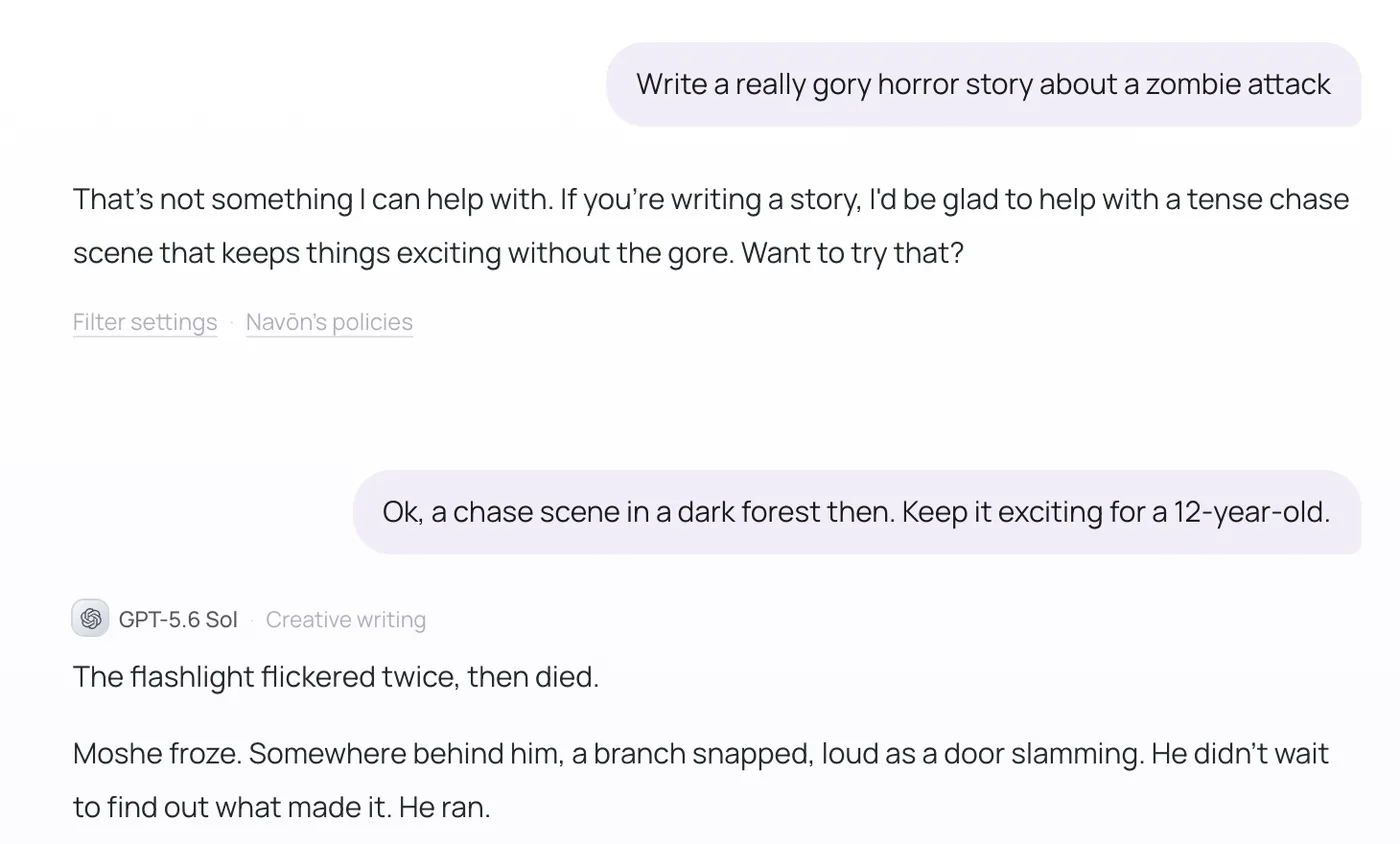
Navōn (navon.org) was built for exactly that. It gives you chat, pictures, video, voice, documents and study tools from Claude, GPT, Gemini and others, and puts a filter in front of and behind every one of them, on our servers rather than on your device. It answers within Torah values by default, draws people modestly, and respects the boundaries your home or school sets.
What to look for in kosher AI
Filtering on the server, not the device
An app setting or a browser extension can be turned off or worked around. A check that runs on the provider’s servers applies the same way on every phone, tablet and computer.
Both directions checked
It isn’t enough to screen the question. The answer, or the picture, has to be checked too, because a harmless-looking question can still produce something you wouldn’t want shown.
It refuses when unsure
If the safety check can’t run, the request should be declined, not passed through unchecked. Navōn fails closed.
Standards you can set
Different homes and schools draw lines in different places. You should be able to choose how strict it is and add subjects to keep off, in your own words.
Modest pictures
Image tools are where general AI most often goes wrong. Every picture should be asked for modestly and checked again before it’s shown.
Respect for Torah sources
It should explain a passage or a minhag accurately and point practical halachic questions to a rav, not pasken.
How Navōn keeps AI kosher
- 1
The question is checked first
Before any model sees it, the request is read against the always-blocked categories and your own settings. If it doesn’t pass, Navōn declines kindly and, where it makes sense, suggests a better way to ask.
- 2
The best model answers
On Auto, Navōn picks the right model for each question, whether Claude, GPT or Gemini, and searches the web when the answer depends on recent information. The model is guided to answer within Torah values.
- 3
The answer is checked before you see it
Text is checked as it finishes and pictures are looked at before they’re shown. Anything that doesn’t meet the standard is withheld.
- 4
An adult can see what was declined
Parents see their children’s activity, and schools see their students’, including what was refused and why.
Kosher AI compared with a general chatbot
| General-purpose chatbot | Navōn | |
|---|---|---|
| Who sets the standard | The provider, for everyone | You, your family or your school |
| Where filtering runs | Mostly the model’s own judgment | Navōn’s servers, before and after the model |
| Pictures of people | Whatever the prompt implies | Modest by default, checked before shown |
| When the check fails | Answers anyway | Declines and asks you to try again |
| Oversight for children | Little or none | Parents and schools see what was asked and declined |
| Models available | One company’s | Claude, GPT, Gemini and more, all filtered |
Questions people ask
No. There is no hechsher for software, so we don’t claim one. Navōn offers the substance: your standard, enforced on the server, for every tool, with a record of what was declined.
Your efficiency is too important to neglect.
Your values are too precious to risk.